 by
Noisy pipes when heating comes on uk homeowners hear every autumn are rarely a mystery. The sound itself tells you most of what you need to know. A bang, a tick, a gurgle, and a kettle-like rumble each point to a different cause, and each cause has a different fix. Some you can sort yourself in ten minutes. Others need a Gas Safe engineer. This guide helps you match the noise to the cause, try the safe checks first, and know when to pick up the phone.
Most noisy pipes are harmless. Copper pipes grow as they heat up, and they tick as they rub against floorboards. Air trapped in the system gurgles as the pump pushes it around. But a few noises warn of a real fault. A single loud bang when the boiler lights, or a kettle sound from the boiler itself, needs an engineer. So start by listening carefully, and note when the noise happens and where it comes from. That detail saves time for any engineer you call.
What the Noise Tells You
Before you touch anything, work out which sound you hear. The table below matches each common noise to its most likely cause. Use it as a rough guide, not a diagnosis. If two causes fit, try the easy checks first.
| What you hear | When it happens | Most likely cause |
|---|---|---|
| Banging or knocking | As the heating starts, or when a tap shuts fast | Water hammer, or loose pipes moving |
| Ticking or clicking | As pipes warm up, then again as they cool | Copper pipes expanding against joists |
| Gurgling or trickling | As water starts moving through radiators | Air trapped in the system |
| Humming or vibrating | Soon after the boiler starts | Pump running fast, or a stuck pump |
| Rumbling like a kettle | Once the boiler is hot | Sludge or limescale, water boiling in the boiler |
| One loud bang at ignition | As the burner lights | Delayed ignition — call an engineer |
Now work through the causes one by one. Start with the easy ones. Bleeding radiators and checking the boiler pressure take ten minutes and need no tools beyond a bleed key. If those steps do not help, move on to the sections below.
Why Pipes Tick as They Heat Up
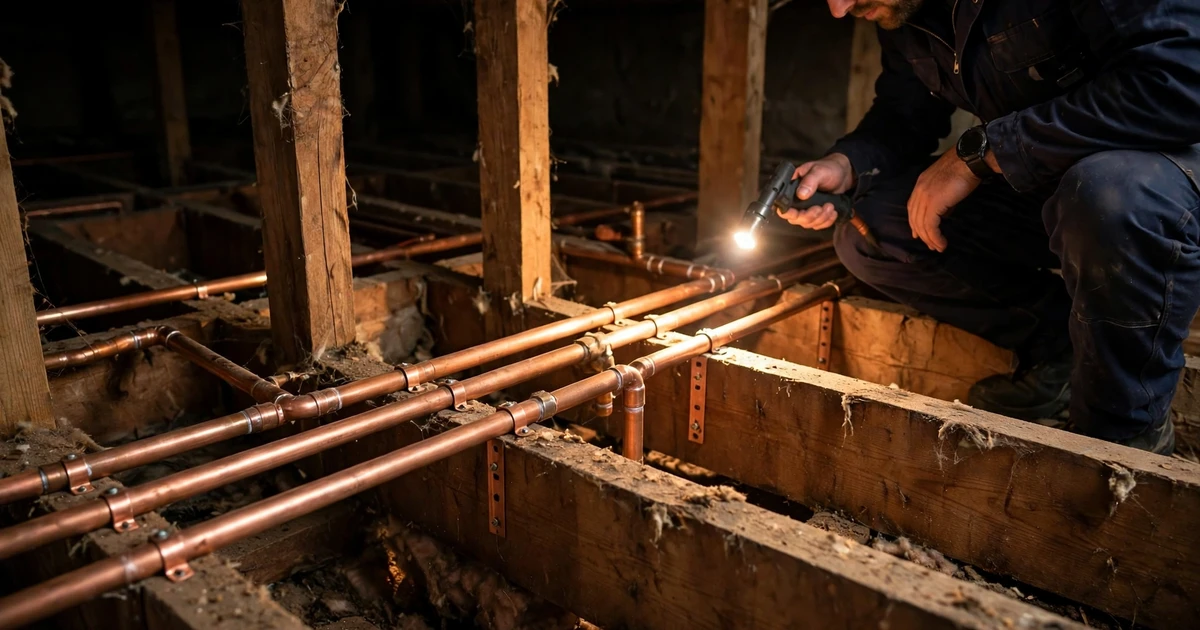
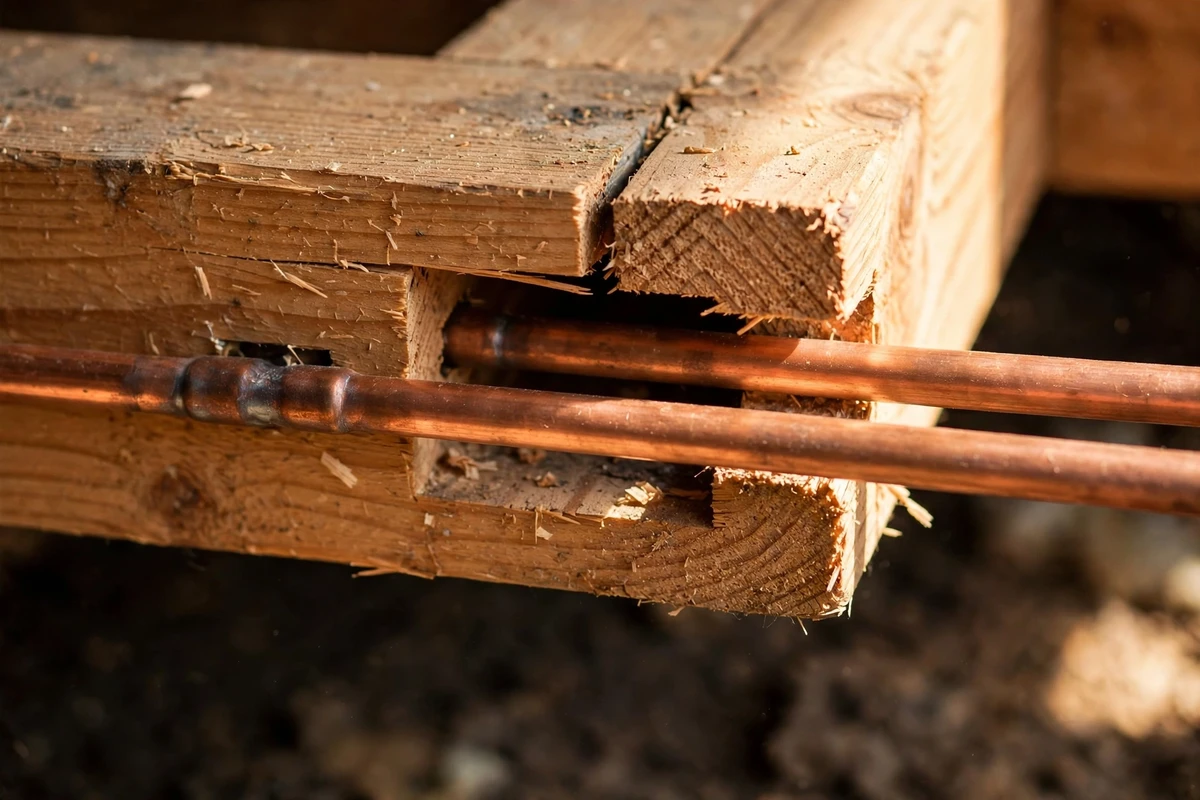
Copper pipes grow slightly as they heat up, and they shrink as they cool down. That growth is tiny, but it is enough to make a pipe rub against a floor joist or a notch in the timber. The rub makes a tick or a click. You hear it most in the first ten minutes after the heating starts, and again when the heating goes off. It often sounds like it comes from under the floor, and it can be loud enough to wake you at night.
This noise is normal in most UK homes. It does not mean the pipes are faulty. It only becomes a problem if it is very loud, or if it goes on for a long time after the system is warm. In that case, the pipes may sit too tight in their notches, with no room to move. A heating engineer can fix it by widening the notches, or by fitting felt or foam lagging around the pipes where they pass through joists.
You can test this cause yourself. Note whether the ticking follows the heating cycle, and whether it stops once the house is warm. If it does, expansion is the cause. If the ticking carries on all day, look at the other causes below. Do not lift floorboards yourself unless you know where the pipes run, as you can damage a pipe with a saw or a nail.
Air Trapped in the System
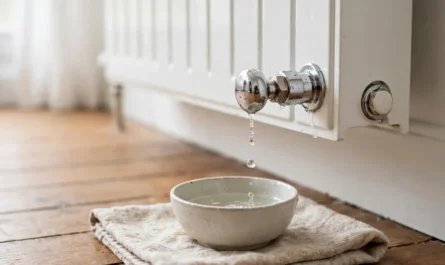
Air gathers at high points in a heating system while it sits unused over summer. When the pump starts again in autumn, it pushes that air around the pipes. The result is gurgling, trickling, and the odd thump. You may also notice a radiator that is hot at the bottom and cold at the top. That cold top is air, and it stops the radiator from heating properly.
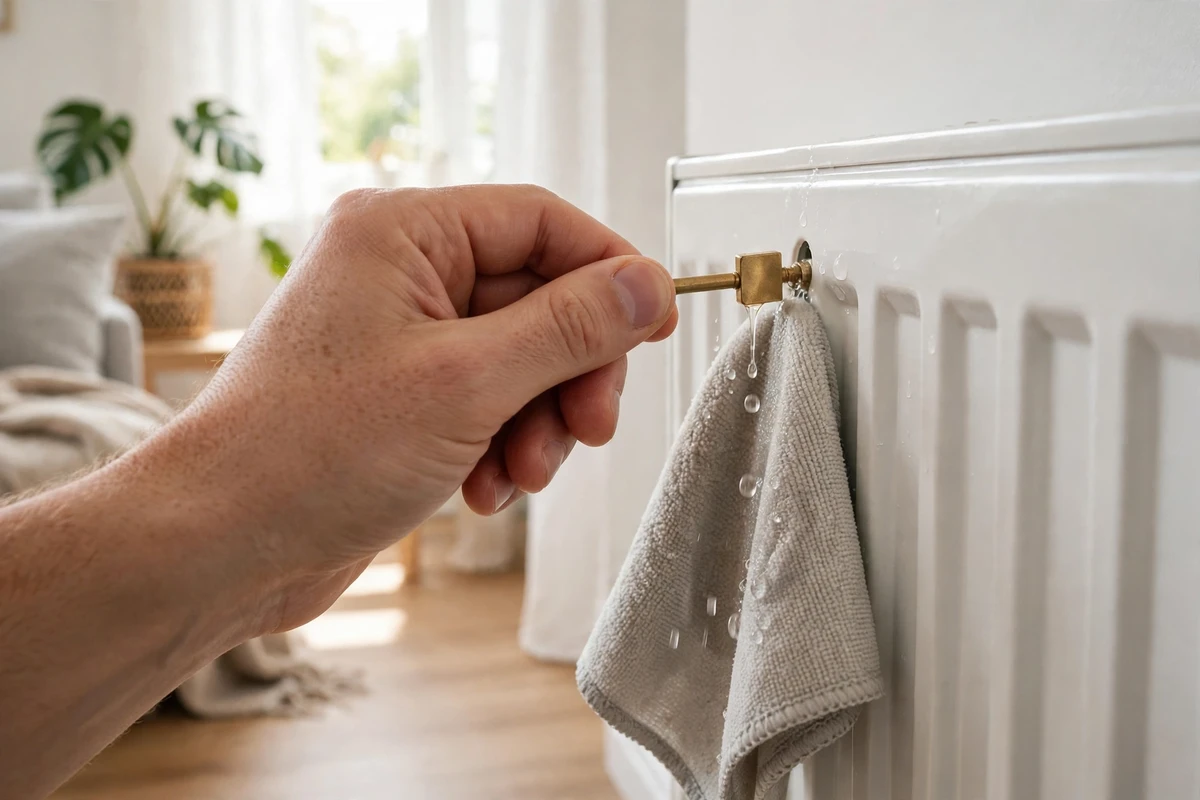
Bleeding the radiators fixes this in most cases. You need a radiator bleed key and an old towel. Turn the heating off and let the radiators cool for half an hour. Then start with the radiator lowest in the house, and work your way up. Hold the towel under the bleed valve, turn the key a quarter turn, and listen for the hiss of escaping air. When water starts to drip out, close the valve. Then move on to the next radiator.
After bleeding, check the boiler pressure. Most sealed systems run at 1 to 1.5 bar when cold, and the gauge sits on or under the boiler. Bleeding lets air out, and the pressure drops. If it falls below 1 bar, top the system up through the filling loop. Our guide to why your boiler loses pressure explains the safe top-up steps in full. If the pressure keeps dropping after you top it up, the system has a leak, and you need an engineer.
If the gurgling comes back within a few days, air is getting into the system somewhere. A common cause is a faulty automatic air vent, or a leak on a joint that lets air in as the system cools. An engineer can find and fix that. Do not keep bleeding the radiators every week without finding the cause, as each bleed lets in fresh water, and fresh water brings oxygen that rusts the inside of the system.
The Pump Stuck After Summer
A central heating pump that sits idle for months can stick. The first time the heating runs after summer, a stuck pump hums, then bangs, or it runs slowly and the radiators heat unevenly. Some pumps make a grinding noise as they try to turn. This is common on older systems, and it is worse in hard-water areas where limescale builds up on the pump shaft.
On some pumps, you can free the shaft yourself. Turn the power to the boiler off at the fused spur. Then find the large screw in the centre of the pump body, and turn it gently with a flathead screwdriver. A few turns can free a stuck shaft. But do not open the pump casing, and do not work on the pump while the power is on. If you are not sure what you are looking at, leave it to an engineer.
A pump that sticks every autumn is telling you it is wearing out. A new pump typically costs £150 to £300 fitted, depending on the model and your area. An engineer can also fit a magnetic filter at the same time, which catches sludge before it reaches the pump. That one step can add years to a pump’s life.
Sludge and Limescale: The Kettle Sound
If your boiler sounds like a kettle, the water inside it is boiling in one spot instead of flowing freely. The usual cause is sludge or limescale. Sludge is rust that breaks off the inside of radiators and pipes, then settles in the boiler and the radiators. Limescale builds up in hard-water areas, and it coats the inside of the heat exchanger. Both restrict the flow, so the water overheats where it sits still.
Sludge also causes other symptoms. Radiators may be cold at the bottom and hot at the top, which is the opposite of the air problem. Our guide to a radiator that is cold at the bottom explains how to test for sludge and what a flush involves. You may also notice the boiler cutting out, or the radiators taking a long time to heat up.
The fix is a system flush, plus a dose of inhibitor to stop rust forming again. A power flush typically costs £300 to £600 for a standard house, depending on the number of radiators. A chemical flush costs less, typically £150 to £300, but it works more slowly. A magnetic filter fitted on the return pipe catches sludge as it forms, and it typically costs £100 to £200 fitted. An engineer can advise which option suits your system.
Loose Pipes and Clips
Pipes that are not clipped firmly can move as hot water rushes through them. The movement makes a bang, a rattle, or a vibration, and it often sounds worse near floorboards or stud walls. Over time, clips work loose, or a pipe that was never clipped properly starts to knock against the timber. This is common in older homes, and in extensions where the pipework was added in a hurry.
You can check this cause by listening for where the noise comes from. If it comes from one spot, and it happens every time the heating starts, a loose clip is likely. The fix is simple for an engineer: lift the floorboard, refix the clip, and add felt lagging where the pipe touches the joist. The job takes an hour or two, and it typically costs £80 to £150 for labour.
Do not try to fix loose pipes by wedging wood or foam into the gap yourself. A tight wedge can stop the pipe from expanding, and that can stress the joints. Leave the clipping to someone who can see the pipe and judge how much room it needs.
High Water Pressure and Water Hammer
Water hammer is the loud bang you hear when a tap or a valve shuts fast. The water at the far end of the pipe stops at once, but the water behind it keeps moving. That sudden stop sends a shock wave back through the pipe, and you hear it as a bang. It happens most with quarter-turn lever taps, because they shut off in a fraction of a second. It can also happen when a washing machine or dishwasher valve closes.
High water pressure makes water hammer worse. If your taps sound like a fire hose when they run, or if the pipes bang when you shut a tap, check the pressure. Most UK homes run at 1 to 3 bar from the mains. A plumber can fit a pressure reducing valve, which typically costs £100 to £200 fitted. That one fitting often stops the banging for good.
For a quick test, close taps slowly and see if the bang stops. If it does, water hammer is the cause. Long-term fixes include fitting shock arresters near the fast-closing valve, or refitting the pipework so long straight runs have room to absorb the shock. Both are plumber jobs, and both are cheaper than leaving the banging to wear out joints over time.
Safe Checks You Can Do Yourself
Work through these checks in order, before you call anyone. They cover the most common causes of noisy pipes when heating comes on uk homes face each autumn. Stop at any step where you find water, damp, or a smell of gas. If you smell gas, leave the house and call the National Gas Emergency Service on 0800 111 999. Never open the boiler casing. Gas work is for a Gas Safe registered engineer only.
First, listen and note the details. Write down the sound, when it happens, and where it comes from. That note helps any engineer you call, and it helps you tell expansion ticking from a real fault. Next, bleed the radiators, starting at the lowest one. Then check the boiler pressure, and top it up if it has fallen below 1 bar.
After that, check the radiators for cold spots. Run your hand over each one when the heating has been on for 20 minutes. A cold top means air, and a cold bottom means sludge. Both have their own fixes, and both are covered in our heating guides. Finally, check that the pump is running. Put your hand on the pump body and feel for a gentle vibration. No vibration at all can mean a stuck pump or no power to it.
If these checks do not settle the noise, do not keep trying things at random. A noise that carries on after bleeding and topping up needs an engineer. Tell them what you have already tried, and what you heard. That saves them time, and it saves you money.
What It Typically Costs to Fix Noisy Pipes
Costs vary by region, and London costs more than the rest of the UK. The table below shows typical UK costs for the common fixes. Most heating engineers charge a call-out fee of typically £40 to £60, then an hourly rate of typically £50 to £80.
| Fix | Typical cost |
|---|---|
| Bleed radiators (DIY) | Free, plus a bleed key at typically £1 to £3 |
| Refix loose pipe clips | Typically £80 to £150 |
| Pressure reducing valve fitted | Typically £100 to £200 |
| Replacement circulating pump | Typically £150 to £300 fitted |
| Chemical flush + inhibitor | Typically £150 to £300 |
| Power flush + magnetic filter | Typically £300 to £600 |
| Pipe lagging in joists | Typically £100 to £250 |
Ask the engineer for a fixed price before they start, and ask what the price includes. A power flush should include a dose of inhibitor and a check of the boiler pressure afterwards. A pump replacement should include bleeding the radiators and topping up the system. If the quote seems high, get a second one. Our guide to whether you need a power flush helps you judge if a flush is really needed, or if a cheaper fix will do.
When to Call a Heating Engineer
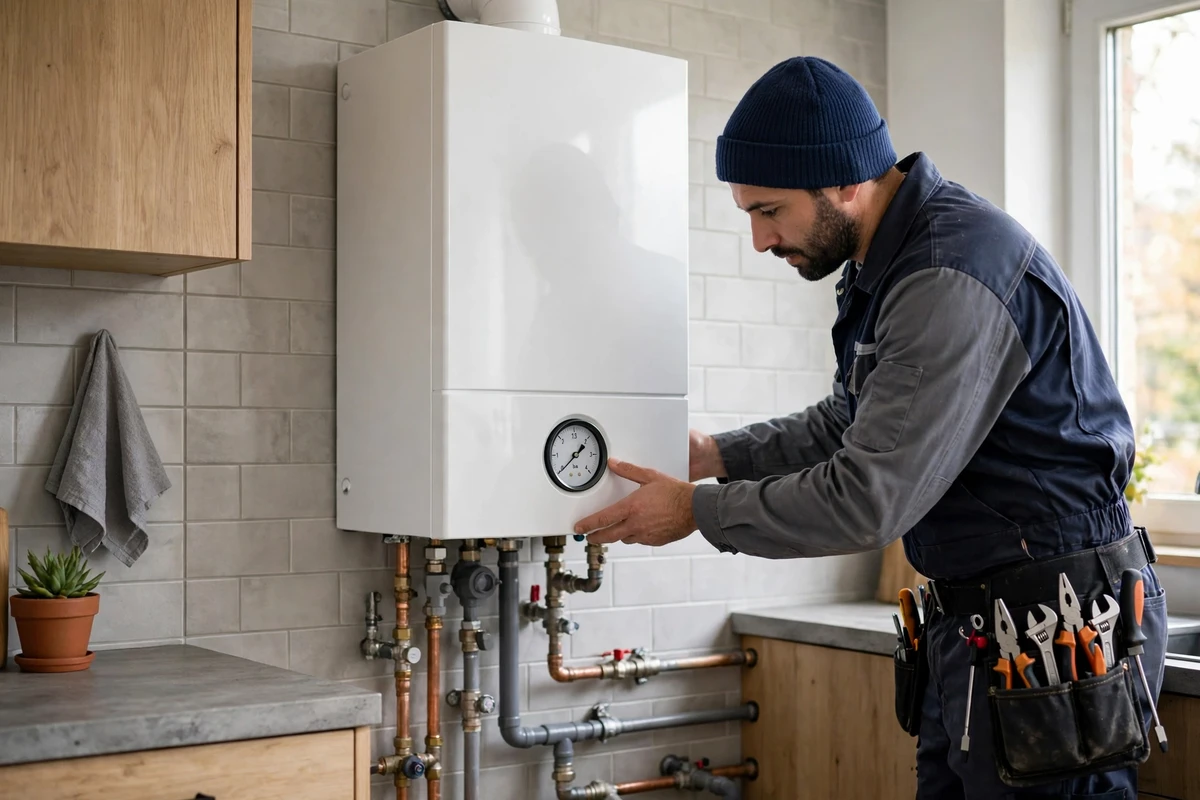
Call an engineer straight away if you hear a single loud bang when the boiler lights. That sound can mean delayed ignition, where gas builds up before it lights. Do not keep running the boiler. Turn it off and call a Gas Safe registered engineer. The same applies if the boiler locks out, shows a fault code, or smells of gas.
Also call an engineer if the noise carries on after you have bled the radiators and topped up the pressure. If the boiler sounds like a kettle, or if the radiators stay cold at the bottom, the system needs a flush or a repair. If the boiler pressure keeps dropping to zero, the system has a leak somewhere, and you need it found before it causes damp. Our guide to boiler pressure loss explains what a falling gauge can mean.
For any gas work, use a Gas Safe registered engineer, and check their registration on the Gas Safe Register before they start. Ask to see their ID card when they arrive. A good engineer will explain the fault in plain English, give you a fixed price, and tell you what you can do to stop the noise coming back.
How to Keep Your Pipes Quiet
Most noisy pipes when heating comes on uk homeowners hear come back if you only fix the symptom. So take a few steps to keep the system healthy. First, keep the inhibitor topped up. Inhibitor stops rust forming inside radiators and pipes, and it slows sludge. An engineer can test the inhibitor level during a service and top it up if needed. The test takes a few minutes, and a top-up typically costs £20 to £40.
Next, fit a magnetic filter if you do not have one. It sits on the return pipe near the boiler, and it catches sludge before it reaches the pump and the heat exchanger. Clean it once a year during the boiler service. Also lag exposed pipes in the loft and under floors. Lagging cuts heat loss, and it stops pipes from knocking against joists as they expand.
Finally, book a boiler service every year, ideally before the heating season starts. A service catches a sticking pump, a worn seal, or a blocked filter before the first cold night. It also keeps the boiler warranty valid on many models. A service typically costs £70 to £120, and it is the cheapest way to keep the whole system quiet.
Frequently Asked Questions
Why are my pipes noisy when the heating comes on?
Noisy pipes when heating comes on uk homes hear are usually caused by one of five things: copper pipes expanding against joists, air trapped in the system, a pump stuck after summer, sludge or limescale in the boiler, or loose pipe clips. Match the sound to the cause: ticking means expansion, gurgling means air, and a kettle sound means sludge or limescale.
Is it normal for pipes to make noise when the heating starts?
Yes, some noise is normal. Copper pipes tick as they heat up and expand, and you may hear gurgling as air moves through the system after summer. The noise should settle within ten to thirty minutes. If it carries on all day, or if it is very loud, the system needs a check.
How do I stop my pipes banging when the heating comes on?
First, bleed the radiators and check the boiler pressure, as air is the most common cause. If the bang happens when a tap shuts fast, close taps more slowly and ask a plumber about a pressure reducing valve. If the bang comes from under the floor, loose clips or tight joist notches are likely, and an engineer needs to refix them.
Can noisy pipes damage my heating system?
Most noisy pipes cause no damage, but some can. Water hammer wears out joints over time, and sludge that makes the boiler kettle can damage the heat exchanger. A single loud bang at ignition is the most serious sign, as it can mean delayed ignition. So do not ignore a noise that is new, very loud, or getting worse.
When should I call an engineer about noisy pipes?
Call a Gas Safe registered engineer if you hear a single loud bang when the boiler lights, if the boiler sounds like a kettle, if the pressure keeps dropping, or if the noise carries on after bleeding the radiators and topping up. Also call one if you smell gas, or if the boiler locks out or shows a fault code.