 by
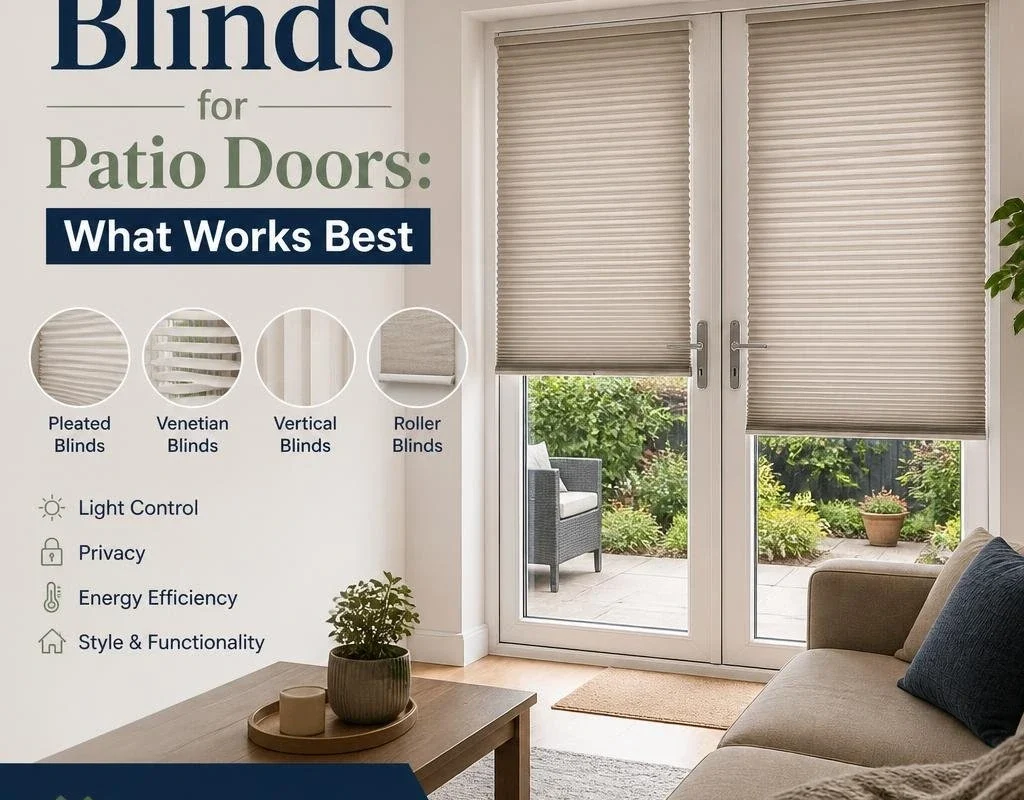
Patio doors need a slightly different approach to blinds than a standard window, mainly because of their size and the fact that they open and close regularly. This guide covers which blind types actually work well for patio doors, and what to consider before choosing.
Why Patio Doors Need a Different Approach
Patio doors are typically wider and taller than standard windows, and since they’re used as a door as much as a window, the blind needs to move out of the way easily without snagging or getting in the way of the door mechanism.
Best Blind Types for Patio Doors
Vertical Blinds
Vertical blinds remain one of the most practical choices for patio doors, since the vanes stack neatly to one side and don’t obstruct the door when open. They’re available in a wide range of fabrics and PVC finishes, making them suitable for most room styles.
Panel Blinds
Panel blinds use wide fabric panels that slide along a track, offering a cleaner, more modern look than traditional verticals. They work particularly well on larger patio doors and bifold doors.
Perfect Fit Blinds
For uPVC or aluminium-framed patio doors, perfect fit blinds clip directly onto the door frame without drilling, and move with the door if needed. These are a popular no-fuss option for renters or anyone wanting to avoid damaging the frame. Our made to measure blinds guide covers this system in more detail.
Roller Blinds on Sliding Track Systems
Specialist sliding roller blind systems, sometimes called “clip and glide” systems, allow multiple roller blinds to run along a track, providing coverage for wide patio or bifold doors while still allowing sections to be opened independently.
Fabric and Material Considerations
Patio doors often let in more direct sunlight than standard windows, so consider a fabric with UV resistance or a blackout lining if the room faces a sunny aspect. Moisture-resistant materials are also worth considering if the door leads directly outside, since condensation can build up more around frequently opened doors.
Measuring Patio Doors for Blinds
Measure the full width and height of the door opening, and decide whether the blind needs to clear the full door for access, or whether it can sit slightly to one side if the door only opens partially. For sliding doors specifically, check how much the door needs to slide before deciding on blind placement.
Child Safety Considerations
Because patio doors are often in living areas where children play, corded blind mechanisms should meet UK child safety standards (BS EN 16433/16434), with breakaway connectors or cord cleats fitted well out of reach. Cordless or motorised options remove this risk entirely, which is worth considering for family homes.
Perfect Fit vs. Freehanging for Patio Doors
The fundamental choice for patio doors is between Perfect Fit blinds — clipped into the glazed frame with no drilling — and freehanging blinds on brackets above. Perfect Fit wins for most patio doors: no damage to frames (crucial for rented homes and warranties), no swaying when doors open, and a superbly neat finish. Freehanging suits very wide spans where individual Perfect Fit units would look fussy, and costs less. Measure each glazed panel separately for Perfect Fit; measure the full recess for freehanging.
Dealing With Handles and Obstructions
Patio door handles are the classic blind-fitting headache. Perfect Fit frames sit within the beading and usually clear standard handles, but deep or projecting handles need checking — measure the handle’s projection and compare with the blind’s depth. For freehanging blinds, mount high enough that the blind clears the handle when lowered, or accept a small gap. Sliding doors avoid the issue entirely since nothing swings. When in doubt, most blind companies offer free measuring services — use them.
Thermal Efficiency at Glass Doors
Patio doors are among the biggest heat losers in a home — large glass areas bleed warmth all winter. Honeycomb (cellular) blinds trap air in their pockets and measurably cut heat loss; thermal roller fabrics help too. Close blinds at dusk as a matter of routine — the habit matters more than the product. For north-facing doors, thermal blinds are close to essential; for south-facing, prioritise solar reflective options to prevent summer overheating instead.
Motorised Options for Large Doors
Wide patio doors make a strong case for motorisation: spanning 3+ metres of blinds by hand gets old fast, and perfectly aligned blinds look far better. Battery-powered motors (recharged via USB every 6–12 months) avoid electrician costs; hardwired suits new builds. Costs have fallen sharply — expect £80–£150 per blind over manual. App and voice control are genuinely useful here, not gimmicks: “close the patio blinds” at sunset beats wrestling with cords.
What to Avoid With Patio Door Blinds
A few choices consistently disappoint. Heavy blackout roller blinds on frequently used doors wear out fast from constant rolling. Very light fabrics show every mark from hands operating the doors. Cords near doors are both a child-safety risk and a snagging nuisance — go cordless or motorised. And avoid dark colours on south-facing glass: they absorb heat, fade fast, and can stress double-glazed seals over time. For bay windows, which share many challenges, see our bay window blinds guide.
Frequently Asked Questions
What’s the best type of blind for sliding patio doors?
Vertical blinds and panel blinds are generally the most practical, since they stack neatly to one side without blocking the door.
Can I fit blinds to a patio door without drilling?
Yes, perfect fit blind systems clip directly onto uPVC or aluminium door frames without drilling into the frame itself.
Do patio door blinds need to be child-safe?
Any corded blind sold in the UK must meet child safety standards, though cordless or motorised options avoid the issue entirely.
What blinds are best for patio doors?
Perfect Fit blinds in pleated, cellular or roller styles suit most patio doors — neat, no drilling, and they move with the door. Wide spans may suit freehanging vertical or panel blinds instead.
Can you put blinds on sliding patio doors?
Yes — vertical blinds, panel blinds and Perfect Fit options all work on sliders. Avoid anything that obstructs the sliding track or catches as doors pass each other.
How do you measure for patio door blinds?
For Perfect Fit, measure each glazed panel’s visible glass area. For freehanging, measure the full recess width and the drop from mounting point to sill or floor.