 by
by Bay windows add character to a room, but their angled shape makes choosing blinds more complicated than a standard flat window. This guide covers the main approaches that work well for bay windows, and how to avoid a bulky or mismatched result.
Why Bay Windows Are Trickier to Fit
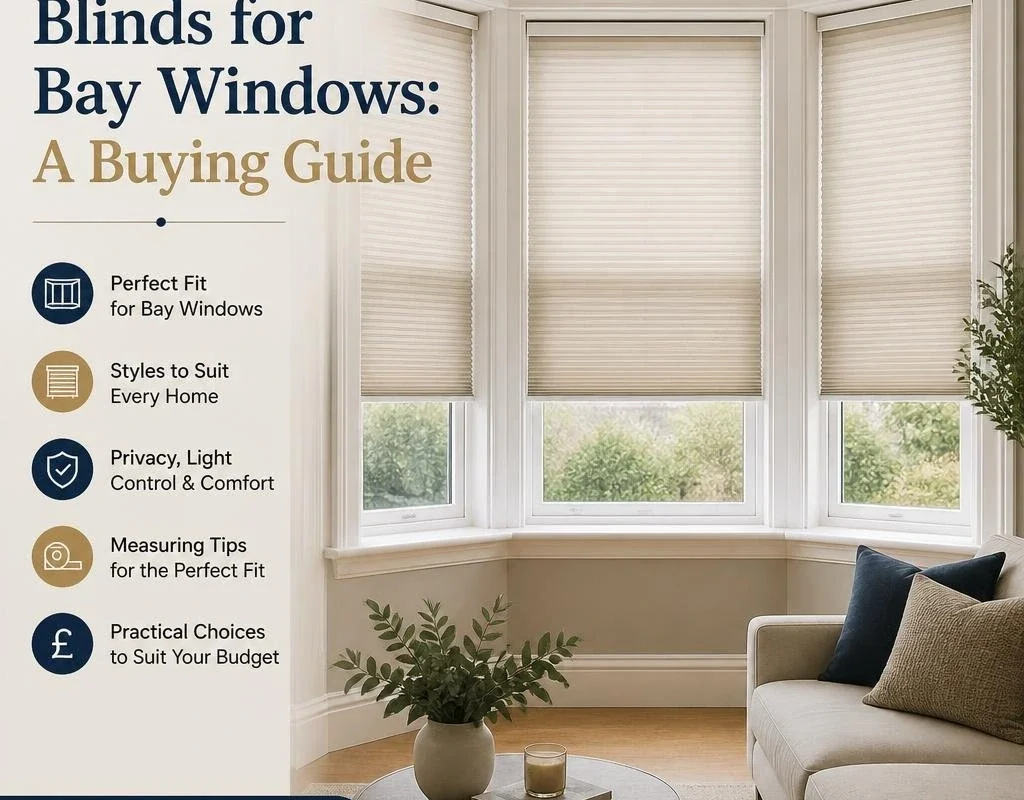
A bay window is really three (or sometimes more) separate window panes set at angles to each other, rather than one continuous window. This means a single large blind rarely fits well, and most bay windows are better served by fitting an individual blind to each pane.
Individual Blinds Per Pane vs. One Large Blind
Fitting a separate blind to each pane, all in a matching style and fabric, is the most common and generally the neatest approach for a bay window. It allows each section to be opened and closed independently, which is useful if some panes get more direct sun than others. A single wide blind covering the whole bay is possible with specialist curved track systems, but this is a more expensive, specialist option, typically reserved for large or statement bay windows.
Best Blind Types for Bay Windows
- Roller blinds – neat and unobtrusive when fitted individually to each pane
- Venetian blinds – offer precise light control on each section independently
- Roman blinds – add a softer, more decorative look, though they sit slightly more bulky when raised
- Perfect fit blinds – a clean, no-drill option well suited to uPVC bay windows
For a wider comparison of these blind types, our different types of blinds guide covers the pros and cons of each in more depth.
Measuring a Bay Window Correctly
Each pane in a bay window should be measured individually, since angled bays are rarely perfectly symmetrical even when they look it. Measure the width and drop of each section separately, following the same recess or outside-fit approach used for a standard window, and don’t assume all panes share identical measurements.
Choosing a Consistent Look Across Panes
Even with individual blinds, keeping the same fabric, colour, and blind type across all panes creates a cohesive, considered look, rather than a mismatched one. This matters more in a bay window than a single standalone window, since all the panes are visible together as one feature.
Dealing with Corners and Overlaps
Where panes meet at an angle, blind headrails can sometimes clash slightly at the corners. Many made to measure suppliers offer corner brackets or slightly adjusted fittings specifically designed for bay windows, so it’s worth mentioning the bay window shape when ordering.
Light and Privacy Considerations
Bay windows often catch more direct sun than a standard window, thanks to their angled panes facing slightly different directions throughout the day. This makes independently adjustable blinds per pane particularly useful, since you can manage light and privacy pane by pane rather than all at once. For more on our made to measure blinds guide, which covers materials suited to sun exposure in more detail.
Angled Bays vs. Square Bays: What Changes
Not all bays are equal. Angled bays (the classic Victorian 45-degree) need individual blinds per pane with careful corner management — light gaps at angles are the main challenge. Square bays behave more like three flat windows and are simpler to dress. Bow windows (curved) are the trickiest: flexible curved tracks with curtains often work better than blinds. Identify your bay type before shopping; the wrong approach for your geometry wastes money.
Dealing With Window Sills and Radiators
Bay windows often sit above radiators or deep sills. Sill-length blinds keep heat flowing and look tidy; full-length blinds trap heat behind them and get grubby from radiator dust. If the sill is deep enough for plants or ornaments, inside-recess blinds preserve that display space. Measure the sill depth as well as the recess — shallow sills limit which blind types fit neatly inside.
Top-Down Bottom-Up for Bay Windows
Top-down bottom-up blinds are arguably the perfect bay window treatment: lower from the top for daylight while keeping the lower half private — ideal for street-facing bays. They work per-pane, so each section adjusts independently. The mechanism costs more than standard blinds (£20–£40 extra per blind), but for overlooked bays the privacy flexibility justifies it. Honeycomb versions add insulation to these notoriously draughty windows.
Motorising Bay Window Blinds
Five separate blinds adjusted by hand twice daily gets tedious — which makes bays prime candidates for motorisation. Battery motors per blind (recharged by USB every 6–12 months) avoid wiring; group them so one command moves all panes together. Expect £80–£150 per blind over manual cost. The alignment payoff is real: motorised blinds stop at identical positions, giving the crisp uniform look that manual bays rarely achieve.
Common Bay Blind Mistakes
The classics: measuring the whole bay as one width (each pane is separate); ignoring handle clearance on opening panes; choosing heavy blackout rollers that strain under daily use across five panes; and mismatched whites between panes ordered at different times — order all blinds together from one batch. A free professional measuring service avoids nearly all of these; most blind companies offer it. For the full layered look, see our dressing a bay window guide.
Frequently Asked Questions
Should I fit one blind or several for a bay window?
Fitting an individual, matching blind to each pane is generally the neatest and most practical approach for most bay windows.
What’s the best blind type for a bay window?
Roller and venetian blinds tend to work particularly well, since they sit neatly against each pane without adding bulk.
Do all panes in a bay window need the same size blind?
Not necessarily. Always measure each pane individually, since bay windows are rarely perfectly symmetrical.
What is the best blind for a bay window?
Venetian, pleated or honeycomb blinds fitted per pane suit most bays. Top-down bottom-up versions are ideal for street-facing bays needing privacy with daylight.
Should bay window blinds be inside or outside the recess?
Inside the recess per pane is the standard, neatest approach. Outside the recess works when sills are shallow or you want to preserve display space on deep sills.
How much do bay window blinds cost in the UK?
Roughly £40–£120 per pane depending on type and size, so a five-pane bay typically costs £200–£600. Motorisation adds £80–£150 per blind.