 by
by A bay window’s angled shape makes it one of the trickiest to dress well with fabric, since a straight curtain rail simply doesn’t follow the line of the glass. This guide covers how to combine blinds and curtains on a bay window so the result actually works with the shape, rather than fighting it.
Why a Bay Window Needs Both
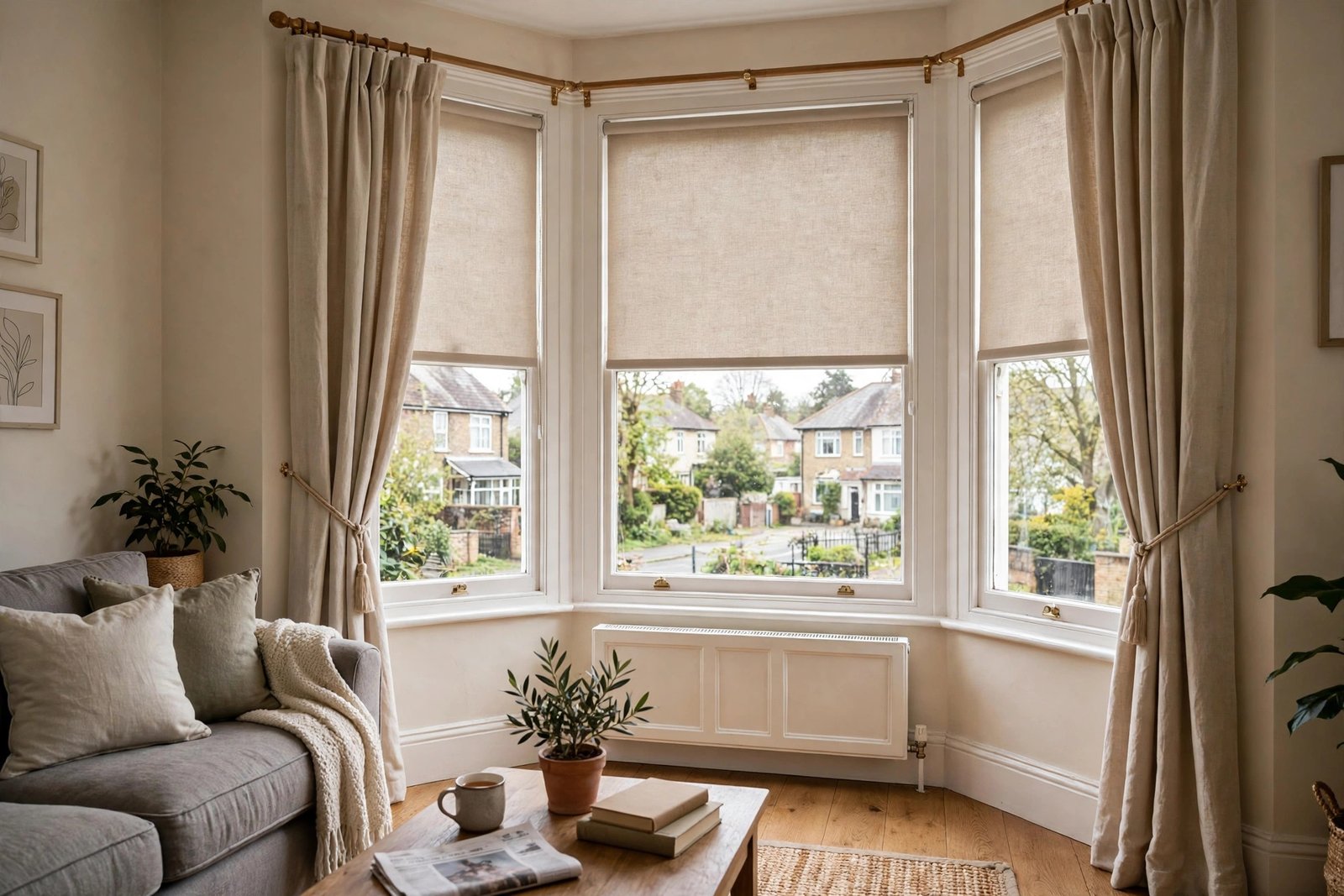
Blinds fitted to each pane give you precise, everyday light control and privacy without needing to touch a heavy curtain. Curtains, hung across the whole bay rather than pane by pane, frame the feature as a single architectural element and add the softness and warmth a run of blinds alone can’t. For the blinds-only approach to a bay window, see our dedicated blinds for bay windows guide — this article focuses specifically on adding curtains into that setup.
Two Ways to Hang the Curtain
A Curved or Angled Track Following the Bay
A track bent or hinged to match the angles of the bay lets the curtain follow the window’s shape closely, so it can be drawn right around the bay for full coverage at night. This gives the most complete blackout and draught protection but needs a track made or adjusted specifically for your bay’s angles, since a standard straight track won’t bend to fit.
A Single Straight Pole Across the Front
Mounting one straight pole across the front of the bay, rather than following its angles, is simpler to fit and gives a cleaner, more architectural look, particularly in a room with a high ceiling. The trade-off is that the curtain doesn’t wrap into the bay itself, so it works better as a framing feature than as full night-time coverage, and the blinds underneath take on more of the privacy and blackout role.
Fitting the Blinds First
Whichever curtain approach you choose, fit the blinds to each pane first, since the curtain hardware needs to clear the blind headrails without catching. As covered in our bay window blinds guide, each pane should be measured individually, since bay windows are rarely perfectly symmetrical even when they look it — this matters even more once a curtain track has to sit in front of all three headrails without interference.
Choosing Curtain Weight and Fullness
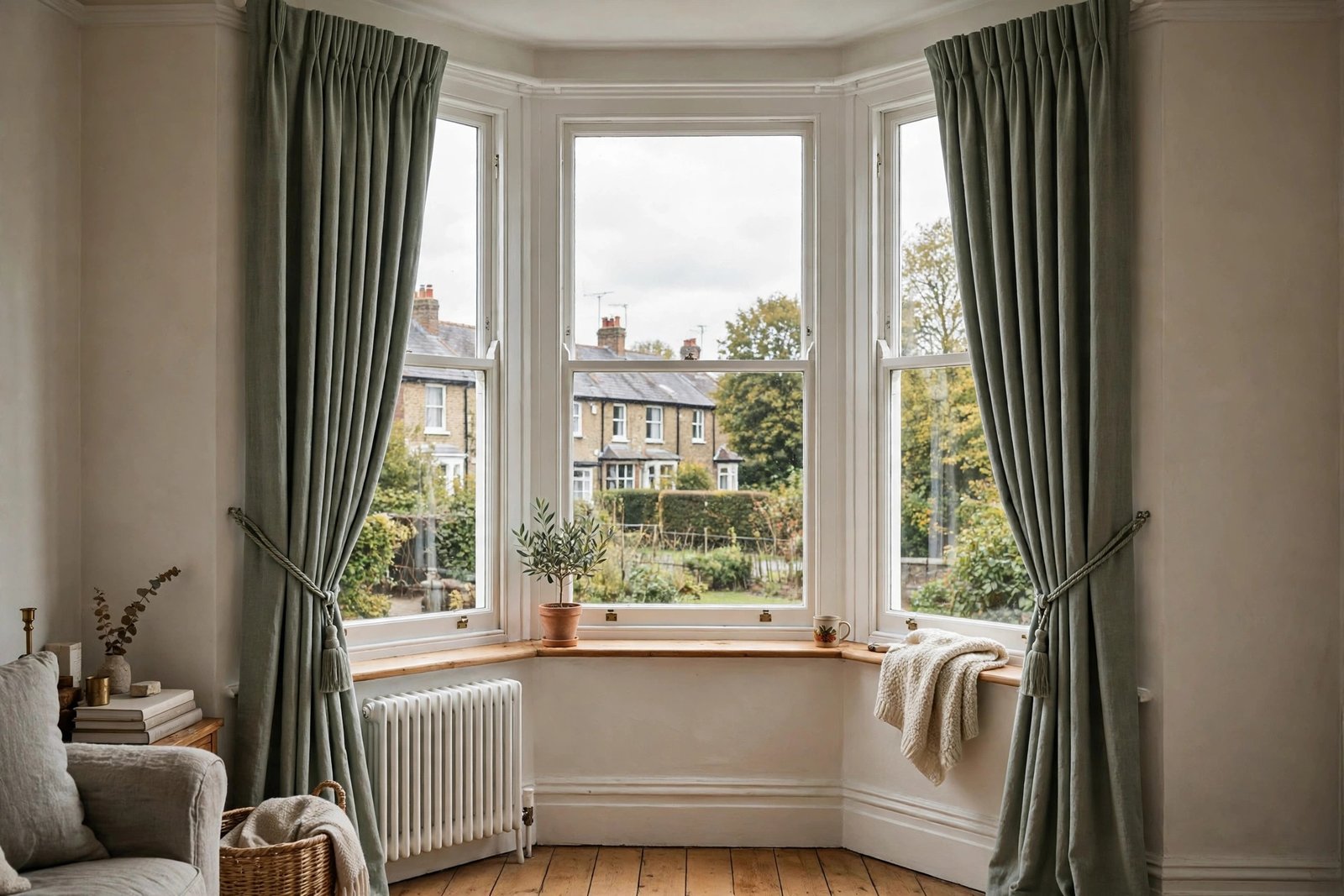
A bay window usually needs more curtain fabric than a flat window of the same width, since the fabric needs enough fullness to wrap around the corners and still hang with a natural fold when open. Lighter fabrics gather more easily around a curved track, while heavier or interlined curtains suit a straight-pole setup better, since they don’t need to bend around any angles.
What to Do With a Window Seat or Radiator
Many UK bay windows include a window seat or a radiator positioned along the base. In this case, curtains that stop just above the seat or sill, rather than pooling to the floor, keep the space usable and avoid trapping heat behind heavy fabric against a radiator. The blinds still handle day-to-day light and privacy at seat height, while the shorter curtains add a framing, decorative role above.
Matching Blinds and Curtains on a Bay Window
Because a bay window displays multiple panes together as one feature, mismatched blinds and curtains stand out more here than on a single window. Keeping the blinds in one consistent colour or fabric across all panes, and choosing a curtain fabric that complements rather than competes with them, keeps the whole feature reading as one considered design rather than three separate windows dressed differently.
Curtain Track Options for Bays
Bay curtain tracks come in two families. Bendable tracks (plastic or aluminium) curve to your bay’s exact angles — versatile and affordable (£30–£80), though plastic versions can look cheap close up. Custom-bent metal tracks are made to your bay’s template — smoother, stronger, pricier (£100–£250). For heavy interlined curtains on a large bay, custom-bent is worth it; the track is the skeleton everything hangs on. Some tracks ceiling-mount for a floor-to-ceiling look that makes bays feel grand — stunning in Victorian properties.
Cost Guide: Dressing a Bay Window
Full bay dressing — blinds plus curtains — is a significant spend. Typical totals: blinds per pane £40–£120 x 5 panes = £200–£600; curtains (wide, full-length) £150–£500; track £30–£250; fitting £80–£200. All-in: £460–£1,550. Save by choosing ready-made curtains (bays need width more than bespoke fit) and DIY fitting — or phase it: blinds first for function, curtains later for the finished look.
Bay Windows in Period Properties
Victorian and Edwardian bays deserve sympathy. Original shutters, if present, are worth restoring — nothing insulates or looks better, and they add genuine period value. For curtains, floor-to-ceiling tracks suit the tall proportions; heavy fabrics (velvet, interlined linen) match the architecture’s gravity. Avoid flimsy modern blinds that fight the room’s character — wooden venetians or classic romans harmonise. And check for listing constraints before drilling into original frames; secondary glazing plus shutters may be the compliant path.
Dealing With Deep Bays
Deep bays (60cm+) are a gift and a puzzle. The depth accommodates a window seat — the classic bay upgrade, adding seating and storage — with cushions and the blinds mounted at the front of the recess. Curtains can then hang at the room side of the bay on a straight track, simplifying everything. Alternatively, dress the bay’s front face only with blinds and leave the sides open for light. Deep bays also suit plant displays beautifully — the light and depth create a natural orangery effect.
Common Bay Dressing Mistakes
The greatest hits of bay regret: curtains too narrow to cover the full bay when closed (measure the whole track path, not the window); blinds and curtains fouling each other (allow 5cm+ clearance); ignoring the radiator usually lurking in the bay (sill-length treatments or a radiator shelf); and mismatched whites across panes ordered separately. Measure twice, order once, and photograph the bay from the room’s main viewpoint before finalising — that is the view you are dressing. Pane-by-pane blind guidance is in our bay window blinds guide.
Frequently Asked Questions
Do I need a curved track for bay window curtains?
Only if you want the curtain to close fully around the bay at night. A straight pole across the front works well if the curtain is mainly decorative, with blinds handling privacy and light control.
Should curtains go all the way to the floor in a bay window?
Not necessarily. If there’s a window seat or radiator along the base, curtains that stop just above it are more practical and avoid blocking heat output.

Is it more expensive to dress a bay window than a standard window?
Generally yes, since a bay window needs individual blinds per pane plus a curtain track shaped or sized for the wider, angled space, both of which use more material than a single flat window.
Should you put curtains and blinds on a bay window?
Both is the premium choice — blinds for precise light control per pane, curtains for warmth, softness and the finished look. Either alone also works; the combination is about luxury, not necessity.
How do you hang curtains on a bay window?
On a bendable or custom-bent curtain track following the bay’s angles, mounted at ceiling or picture-rail height. Allow 5cm+ clearance behind for blinds.
What blinds work best with curtains on a bay window?
Neat per-pane blinds — pleated, honeycomb or slim venetians — that sit close to the glass and leave clearance for the curtains to draw freely.