 by
by You’ve got a perfectly good freestanding fridge freezer, but it sticks out like a sore thumb next to your fitted kitchen. So the obvious question: can a freestanding fridge freezer be integrated — hidden behind cabinet doors like a proper built-in?
Here’s the straight answer: not truly. A freestanding model can’t take furniture doors the way an integrated appliance can. But you can box it in so it looks far more built-in than it does now — if you respect the rules about airflow. Here’s what works, what doesn’t, and when it’s smarter to just buy integrated.
Why Can’t You Just Put Doors on a Freestanding Fridge Freezer?
Integrated and freestanding fridge freezers are engineered differently, and it comes down to three things:
- Door fixings: integrated models have special hinges designed to carry heavy furniture doors. Freestanding doors have their own finished fronts and no fixing points for cabinet doors — there’s simply nothing to attach them to.
- Ventilation: integrated appliances are designed to vent through a plinth grille at the bottom of the housing unit. Freestanding models shed heat from the back and sides, so they need open air around them.
- Dimensions: integrated models are made to fit a standard 600mm-deep housing; freestanding ones are usually deeper (630–700mm) and wider in odd increments, so they won’t sit flush in standard cabinetry anyway.
Could you bodge furniture doors onto a freestanding unit with brackets and hinges? Technically, with enough carpentry, almost anything is possible — but the doors won’t align properly, ventilation will suffer, and you’ll likely void the warranty. It’s one of those jobs that costs more in labour than the saving is worth.
What You Can Do Instead: Box It In
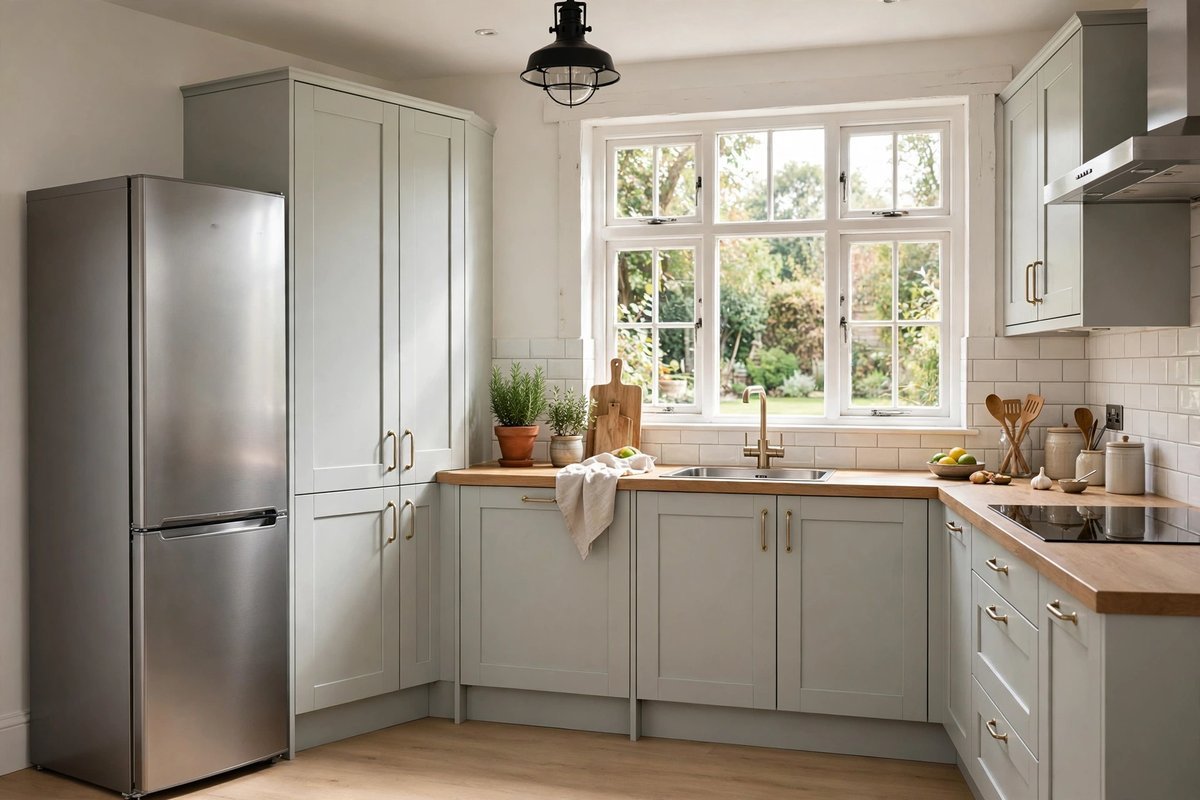
The realistic middle ground is housing the freestanding unit: building cabinetry around it so it reads as part of the run rather than a white box parked at the end. Done well, it looks surprisingly integrated.
Here’s how to do it properly:
- Leave the air gaps. This is non-negotiable. Most manufacturers specify around 20–30mm clearance at the sides, 30–50mm at the back, and 50–100mm above the unit (check your model’s manual — it varies). Without airflow, the compressor works harder, uses more electricity, and dies younger.
- Build a simple carcass. Two tall end panels and a top panel, matched to your kitchen doors, create the “housing” look. A joiner or competent DIYer can do this in a day; materials for a basic surround typically cost £100–£250 depending on finish.
- Add a plinth at the bottom. Running the kitchen plinth across the front of the housing ties it into the rest of the units visually.
- Don’t enclose the back. Leave the rear open to the room or a ventilated void — boxing the back in solid is the classic mistake that cooks compressors.
- Consider a bridging unit above. A shallow wall cabinet spanning over the top of the fridge freezer makes the whole thing look deliberate rather than improvised.
What Are the Risks of Boxing In a Freestanding Unit?
Done badly, housing a freestanding fridge freezer causes real problems — so go in with eyes open:
- Overheating: the number one risk. A compressor starved of airflow runs hot, uses noticeably more energy, and can fail years early. When in doubt, leave bigger gaps.
- Warranty issues: some manufacturers’ warranties assume freestanding installation with the stated clearances. Keep those clearances and you’re fine; enclose it tightly and a warranty claim could get awkward.
- Access for servicing: build the housing so the unit can slide out. If an engineer can’t get behind it, a simple repair becomes a carpentry job.
- Condensation: in a cold spot (a draughty kitchen extension, say), a tightly boxed unit can get condensation on the panels. Ventilation gaps solve this too.
Boxing In vs Buying Integrated: The Cost Comparison
| Box in freestanding | Buy integrated | |
|---|---|---|
| Appliance cost | £0 (keep existing) | Typically £400–£900 for the unit |
| Housing/carpentry | Typically £100–£400 (materials + labour) | Housing unit typically £80–£200 |
| Finish | Looks built-in, but doors are the appliance’s own | Fully flush — furniture doors throughout |
| Ventilation | Needs careful gaps | Designed for it (plinth vent) |
| Capacity | Usually larger (freestanding models are roomier) | Smaller — typically 50/50 or 70/30 splits |
| Future replacement | Any freestanding model fits | Must match the housing dimensions |
The interesting trade-off: freestanding models are usually bigger and cheaper than integrated equivalents. If capacity matters — big family, batch cooking — boxing in your existing unit keeps the litres and saves hundreds. If the seamless look matters more, integrated is the honest answer.
When Should You Just Buy an Integrated Model?
Boxing in is a compromise, and sometimes the compromise isn’t worth it:
- You’re refitting the whole kitchen anyway. If new units are going in, specifying an integrated fridge freezer from the start costs little extra in the scheme of a refit and looks far better.
- The freestanding unit is old. Spending £300 on carpentry around a 12-year-old fridge freezer is questionable economics — put the money toward a new integrated unit instead.
- It’s in the middle of a run, not at the end. Boxing in works best at the end of a cabinet run. Mid-run, the depth mismatch (freestanding units stick out past 600mm units) looks awkward no matter what you do.
- You’re selling soon. Buyers notice bodged kitchens. A proper integrated appliance reads as quality; a boxed-in freestanding unit reads as a workaround.
And a small design note: once the big appliances are sorted, the details carry the room — even something as simple as well-chosen kitchen curtains and blinds can lift a kitchen from “functional” to “finished”.
Frequently Asked Questions
Can a freestanding fridge freezer be integrated?
Not truly — freestanding models can’t take furniture doors like integrated ones, and they’re the wrong dimensions for standard housings. But you can box one in with matching end panels so it looks built-in, as long as you leave the manufacturer’s recommended ventilation gaps.
How much ventilation does a boxed-in fridge freezer need?
Follow your model’s manual, but as a rough guide: 20–30mm at the sides, 30–50mm behind, and 50–100mm above. Never enclose the back solidly. Poor airflow makes the compressor work harder, raises energy use and shortens the appliance’s life.
Will boxing in a fridge freezer void the warranty?
It can, if the installation ignores the manufacturer’s clearance requirements. Keep the specified air gaps, leave the back ventilated, and ensure the unit can be pulled out for servicing — then you’re within normal freestanding installation conditions.
Is it cheaper to box in a freestanding unit or buy integrated?
Boxing in is cheaper if your current unit is in good shape — typically £100–£400 for panels and labour versus £400–£900+ for a new integrated appliance plus housing. But if the freestanding unit is old or you’re refitting the whole kitchen, integrated usually makes more sense.
Can you put a cupboard door on a freestanding fridge?
Not properly. Freestanding fridge doors have no fixings for furniture doors, and the alignment, weight and ventilation all work against it. If you want the furniture-door look, you need an integrated (built-in) appliance designed for it.
The Bottom Line
Can a freestanding fridge freezer be integrated? No — but it can be housed. Box it in with proper ventilation gaps and it will look a world better; chase the true built-in look and you’ll fight the appliance every step of the way. Match the solution to the situation, not the other way round.