 by
There’s a moment in most renovation projects — usually when you’re standing on a cold concrete floor in an extension shell — when someone says it: “Should we just put underfloor heating in?” It sounds like a luxury, and it is, a bit. But the question that always follows is the practical one: what does underfloor heating cost per m2 in the UK?
The honest answer is that it depends almost entirely on which type you choose. Electric underfloor heating is cheap to buy and straightforward to lay. Water-based systems cost noticeably more to install but are cheaper to run year after year. Here’s the full breakdown, with typical UK prices, so you can work out which one suits your project — and your budget.
What Is Underfloor Heating?
Underfloor heating (UFH) warms a room from the floor up instead of from radiators on the walls. Because heat rises evenly across the whole floor, you avoid the classic hot-ceiling, cold-feet problem, and you get your wall space back — no radiators dictating where the sofa goes.
There are two main types, and the cost difference between them is the single biggest thing to understand:
- Electric underfloor heating — thin heating mats or loose cables laid just under the floor finish and wired to the mains. Simple, slim, and ideal for single rooms.
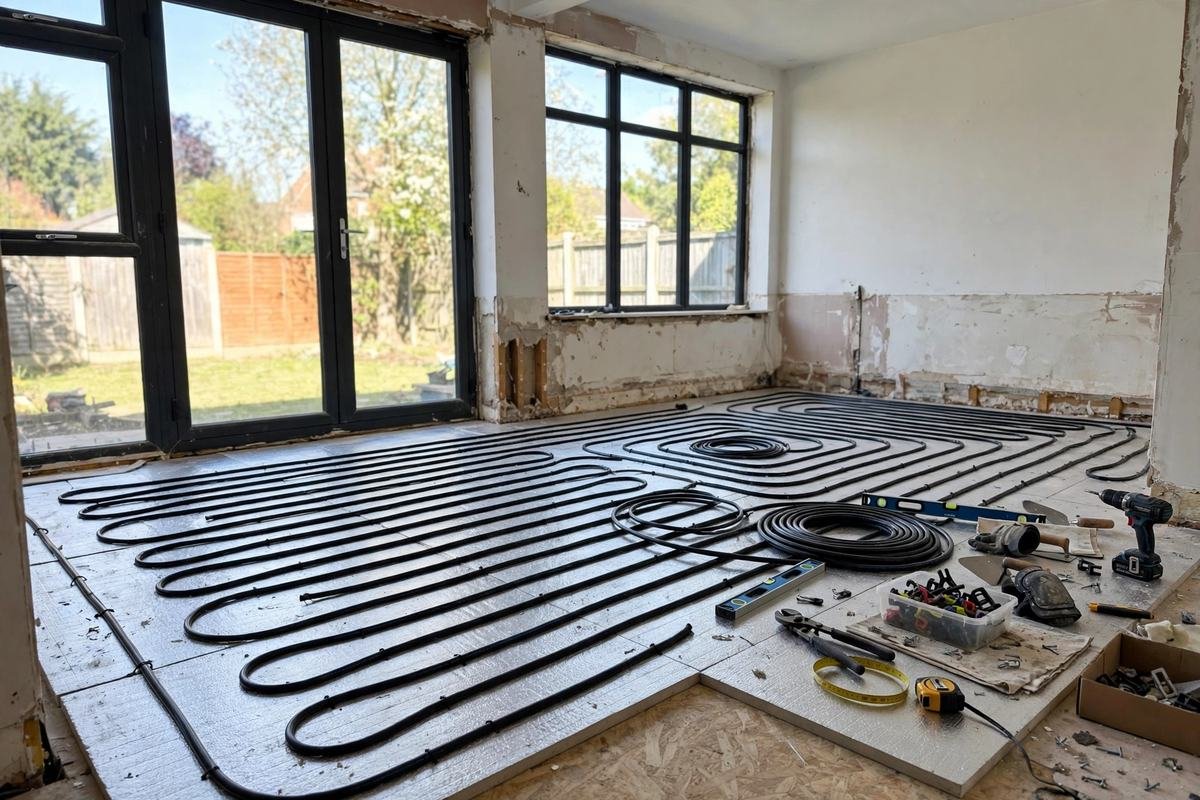
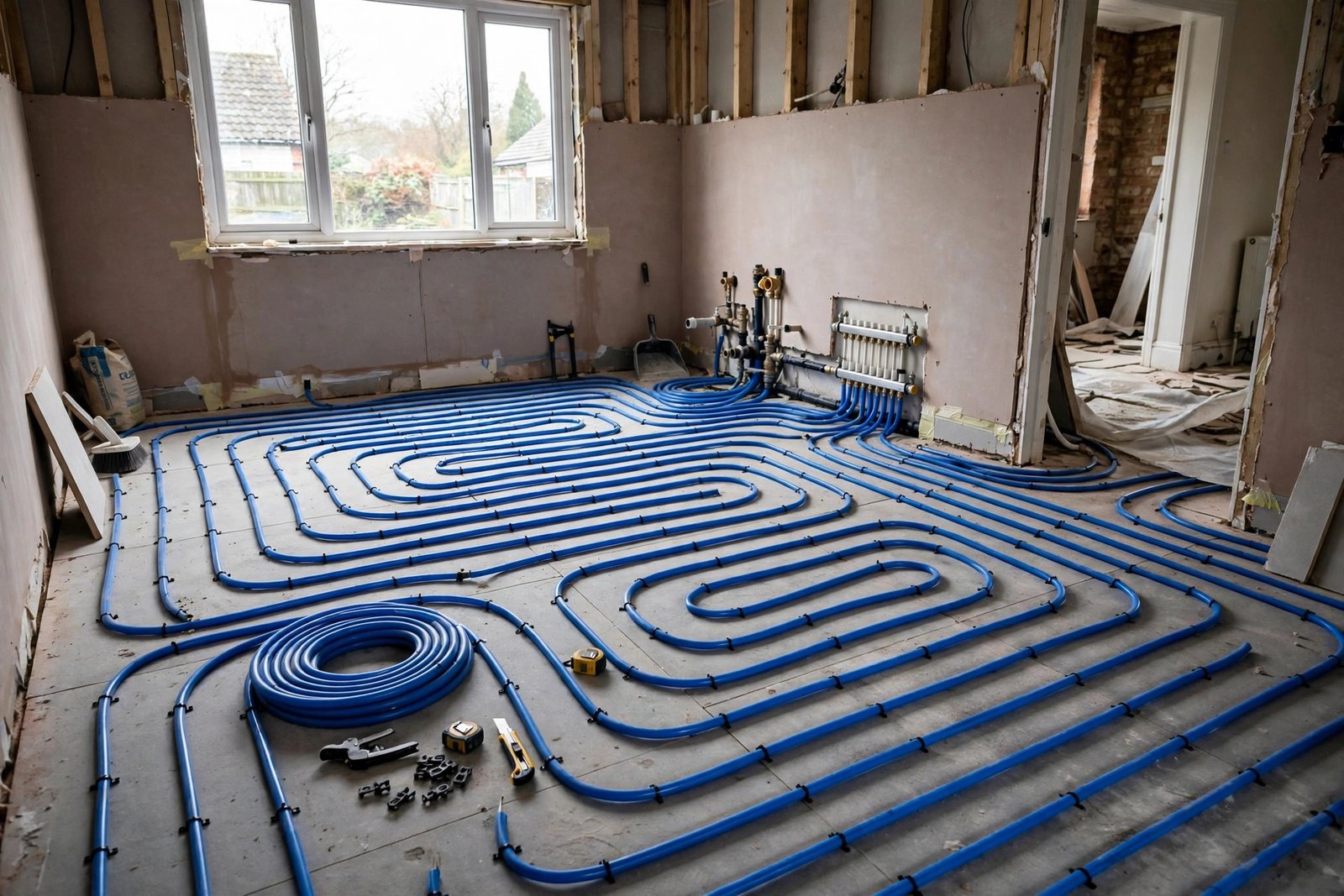
- Water underfloor heating (also called wet or hydronic) — warm water pumped through loops of pipe, connected to your boiler or heat pump via a manifold. More complex to install, but cheaper to run.
Which one you pick changes the per-m2 cost dramatically — so let’s look at the numbers.
How Much Does Underfloor Heating Cost Per m2?
These are typical 2026 UK ranges, before any regional mark-ups. Prices move around, so treat them as budgeting guides rather than quotes:
| System type | Supply-only per m² | Installed per m² |
|---|---|---|
| Electric (heating mats) | £40–£75 | £100–£150 |
| Water (retrofit into existing home) | £30–£60 | £120–£200 |
| Water (new build or extension) | £30–£60 | £90–£140 |
A couple of things worth knowing about these figures. First, the per-m2 price drops on bigger areas — a 30m² open-plan space works out cheaper per square metre than a 4m² ensuite, because the labour for the manifold, controls and testing gets spread further. Second, “installed” for water systems usually means the heating pipework and controls only — it doesn’t include the new floor finish on top, the screed, or any boiler upgrade.
As a rough total for a typical project: expect around £500–£900 to do a small bathroom with electric mats, and roughly £3,000–£6,000 for a water system across a 25–30m² ground floor in a retrofit.
What Pushes the Price Up (or Down)?
Two quotes for “underfloor heating” can be thousands of pounds apart. Here’s why:
- Retrofit vs new build. In a new extension with the slab already going in, water UFH is relatively straightforward. Retrofitting it into an existing home often means digging up floors, raising floor levels, and re-laying everything — that’s where the labour bill climbs.
- Your floor finish. Tiles and stone conduct heat brilliantly and are the ideal partner for UFH. Engineered wood works too. Carpet is possible but needs to be low-tog, and thick underlay will blunt the heat output — which defeats the point.
- Insulation boards. Laying insulation boards beneath the system (especially over concrete) adds roughly £10–£20 per m² in materials, but without them you’re heating the ground as well as the room. Skipping them is a false economy.
- Zones and controls. A single thermostat for one room is cheap. A multi-zone system with a smart thermostat in every room adds several hundred pounds — but lets you heat rooms independently, which saves money long-term.
- Where you live. Labour rates in London and the South East run noticeably higher than in most of the North and Midlands. Get at least three local quotes.
Electric vs Water: Which Is Cheaper Overall?
Here’s the head-to-head that actually matters:
| Electric UFH | Water UFH | |
|---|---|---|
| Upfront cost | Lower — cheaper kits, simpler install | Higher — pipework, manifold, screed, boiler connection |
| Running cost | Higher — electricity costs more per unit of heat | Lower — especially off a gas boiler or heat pump |
| Best for | Single rooms: bathrooms, ensuites, small kitchens | Whole floors, extensions, new builds |
| Floor height added | Minimal — mats are only a few millimetres | More — pipework plus screed can add 50–75mm |
| DIY potential | Reasonable — kits are designed for it | Low — needs professional design and testing |
The rule of thumb most installers use: if you’re heating one room, go electric — the lower install cost wins. If you’re heating a whole floor or an extension, water usually wins over the long run despite the bigger upfront bill, because the running costs are so much lower. If you’re weighing up whole-house electric heating more broadly, our guide to electric heating alternatives covers the other options.
How Much Does Underfloor Heating Cost to Run?
This is where the two systems really diverge. Electric underfloor heating runs on mains electricity, so it’s the most expensive way to produce heat per unit. Heating a typical bathroom with electric mats might add roughly £100–£250 a year to your electricity bill, depending on how much you use it — fine for a room you heat an hour a day, painful for a room you heat all evening.
Water underfloor heating is only as expensive as whatever heats the water. Off a standard gas boiler, running costs are comparable to (often slightly lower than) radiators, because UFH runs at lower water temperatures — around 35–45°C instead of 65–75°C — which suits modern condensing boilers nicely. Paired with a heat pump, which also loves low flow temperatures, it’s about as efficient as domestic heating gets.

One thing that helps both systems: stopping heat escaping in the first place. Underfloor heating in a draughty room is like filling a bath with the plug out — thermal curtains, draught-proofing and decent insulation make any heating system cheaper to run.
Is Underfloor Heating Worth It in the UK?
For most people, the honest pros and cons look like this:
- Comfort: warm floors and even heat are genuinely lovely — especially in bathrooms and kitchens with tiled floors.
- Space: no radiators means full use of your walls, which matters in small rooms.
- Efficiency: water UFH at low temperatures pairs beautifully with heat pumps and modern boilers.
- Cost: it’s never the cheapest option upfront, and electric UFH is never the cheapest to run.
- Responsiveness: water systems in screed are slow to warm up and slow to cool down — great for steady background heat, less good if you want instant warmth.
Worth it? For a bathroom or kitchen renovation where the floor is coming up anyway — very often yes. For a whole house, it makes most sense in well-insulated homes, extensions and new builds. In a draughty Victorian terrace, sort the insulation and draughts first; underfloor heating can’t fix heat loss through single glazing and uninsulated walls.
Can You Install Underfloor Heating Yourself?
Electric systems: often, yes. The mat kits are designed for competent DIYers — you roll out the mat, stick it down, and tile over it. The one non-negotiable is the electrical connection: in the UK, connecting the system to the mains and signing it off needs a qualified electrician (it’s notifiable work under Part P of the Building Regulations).
Water systems: this is professional territory. The pipe layout needs designing for even heat output, the system needs pressure-testing before the screed goes down (finding a leak afterwards is a nightmare), and the manifold has to be correctly connected to your heat source. Get it wrong and you’ve buried the evidence under concrete.
Frequently Asked Questions
How much does underfloor heating cost per m2 in the UK?
Typically £100–£150 per m² installed for electric systems, and £120–£200 per m² installed for water systems in a retrofit (£90–£140 per m² in a new build or extension). Supply-only kits start from around £30–£75 per m² depending on the type.
Is electric or water underfloor heating cheaper to run?
Water is cheaper to run — often significantly — because it’s heated by your boiler or heat pump rather than mains electricity. Electric underfloor heating is cheap to install but expensive to run, which is why it suits single rooms used for short periods, like bathrooms.
Can you put underfloor heating under carpet or laminate?
Yes, with limits. Tiles and stone work best because they conduct heat well. Laminate and engineered wood are fine if rated suitable for UFH. Carpet is possible but keep the combined tog rating of carpet and underlay low — most manufacturers recommend staying under around 2.5 tog — or the heat simply won’t get through.
Does underfloor heating work in old houses?
Yes, but retrofitting costs more. The main challenges are floor height (water systems add 50–75mm), getting insulation under the system, and the fact that draughty older homes lose heat faster than UFH can comfortably replace. Sort insulation and draught-proofing alongside the install.
How long does underfloor heating last?
Manufacturers typically quote around 25 years or more for electric systems and 50 years for water pipework. In practice, the pipework usually outlives the controls and thermostats, which may need replacing once or twice over the system’s life.
The Bottom Line
Underfloor heating costs roughly £100–£150 per m² installed for electric and £120–£200 per m² for water in a retrofit. Choose electric for single rooms where the floor is already coming up, and water for larger areas, extensions and new builds where the lower running costs pay back the bigger upfront investment. Either way, insulate first — the cheapest heat is the heat you don’t lose.