 by
by Smart boilers and smart heating controls promise lower bills and more convenient heating, but they come at a cost. This guide looks at what smart boilers actually offer, and whether the upgrade is worth it for your home.
What Counts as a “Smart Boiler”?
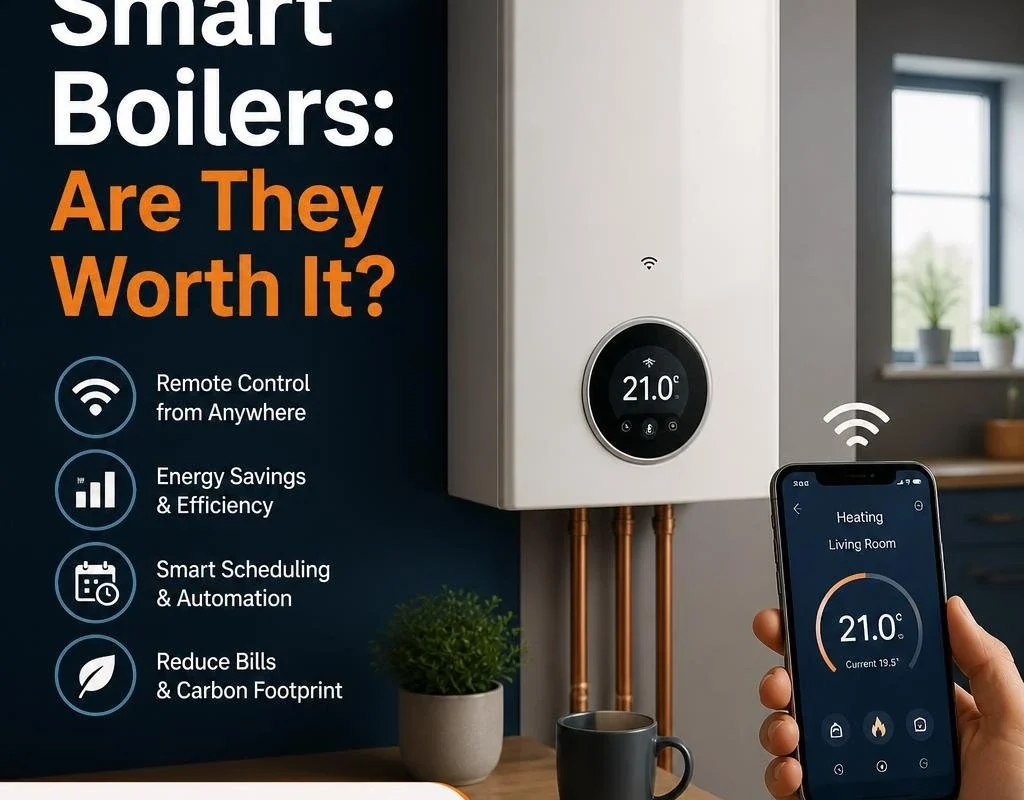
Strictly speaking, a smart boiler is one built with internet connectivity and app control included. More commonly, “smart boiler” refers to a standard boiler paired with a smart thermostat, such as those compatible with the OpenTherm communication standard, which allows finer control over heating output than a basic on/off thermostat.
Boiler Plus and Efficiency Standards
Under the UK government’s Boiler Plus standard, new combi boiler installations in England must include specific efficiency measures, such as smart heating controls with automation and optimisation features. This has pushed smart controls from a nice-to-have into a near-standard part of many new installations. Boiler efficiency itself is also rated under the ErP (Energy related Products) scheme, with A-rated boilers representing the most efficient models.
What Smart Controls Actually Do
- Learning and scheduling – some systems learn your routine and adjust heating times automatically
- Remote control via app – turn heating on or off, or adjust temperature, from outside the home
- Room-by-room control – when paired with smart thermostatic radiator valves (TRVs), heat only occupied rooms
- Weather compensation – some systems adjust flow temperature based on outdoor conditions, improving efficiency
Do Smart Boilers Actually Save Money?
Savings depend heavily on your existing habits. Households that previously left heating running constantly, or heated empty rooms unnecessarily, tend to see the biggest improvement. For those already heating efficiently, the savings may be more modest. Our guide to heating a house for cheap covers other low-cost ways to reduce bills alongside or instead of a smart upgrade.
Installation and Compatibility
Most smart thermostats can be retrofitted to an existing boiler by a Gas Safe registered engineer, without needing to replace the boiler itself. However, compatibility varies by boiler brand and age, so it’s worth checking this before buying a specific smart control.
Smart Controls vs. a New Boiler
If your existing boiler is reasonably efficient and well-maintained, adding smart controls is usually a cheaper first step than replacing the whole system. If you’re considering a full system change, our heat pump running costs guide covers a lower-carbon alternative worth comparing.
Real-World Savings: What Households Actually Report
Manufacturer claims deserve scepticism, so what do real households see? UK trials and user reports suggest smart thermostats typically cut heating bills by 8 to 16%, with the biggest savings in homes that previously heated on crude timers. Zoned smart radiator valves add further savings for households that only use some rooms — commonly another 5 to 10%. Homes already well-controlled save less; the technology mostly eliminates waste rather than creating efficiency. Expect £100 to £250 a year for a typical semi — meaningful, but not miraculous.
Compatibility Checker: Will Smart Controls Work With Your Boiler?
Most smart thermostats work with combi, system and regular boilers from the last 20 years, but there are exceptions. Very old boilers with simple on/off wiring are usually fine; the tricky cases are proprietary communicating systems (some Worcester Bosch and Vaillant models) where third-party thermostats lose advanced features. Heat pumps need heat-pump-specific controls, not boiler thermostats. Before buying, check the thermostat maker’s online compatibility tool — all major brands offer one — and confirm whether your boiler uses standard 230V switching or a proprietary bus.
Installation Costs and Payback Periods
A smart thermostat costs £150 to £250 plus £80 to £150 for professional installation, though confident DIYers can self-install most models in under an hour. Smart radiator valves run £30 to £60 each — a typical house needs 6 to 10. At £150 annual savings, a £300 thermostat setup pays back in two years; full-house smart valves take longer at 4 to 6 years. These maths improve as energy prices rise and worsen if your heating was already well controlled.
Smart Thermostats Compared: The Main Approaches
Broadly, three philosophies compete. Learning thermostats study your routine and program themselves — great for regular schedules, less so for chaotic ones. Geofencing models use phone location to heat only when someone is home, ideal for unpredictable routines. Zoned systems with per-room sensors suit larger homes with varying occupancy. Avoid overbuying: a single learning thermostat transforms a small flat, while a five-bedroom house benefits most from zoning. For cutting bills without new hardware, our cheap heating guide covers the fundamentals.
What Happens If Your Internet Goes Down?
A common worry with an easy answer: heating keeps working. Smart thermostats fall back to their last schedule or a basic manual mode when Wi-Fi drops — your house will not freeze because the broadband did. You lose remote control and learning features until connectivity returns, but core time-and-temperature control continues locally. Battery-backed models ride through power cuts too. It is one area where the technology is more robust than its reputation suggests.
Frequently Asked Questions
Do I need a new boiler to use smart heating controls?
Not usually. Most smart thermostats can be fitted to an existing boiler, provided it’s compatible with the chosen system.
Is Boiler Plus a legal requirement?
Yes, for new combi boiler installations in England, Boiler Plus efficiency measures are a building regulations requirement.
How much do smart heating controls typically save?
Savings vary by household, but they’re generally greatest for homes that previously heated inefficiently or left the system running unnecessarily.
Are smart boilers worth it in the UK?
Smart controls are usually worth it, typically saving 8–16% on heating bills with a 2–4 year payback. Replacing a working boiler just to get ‘smart’ features rarely pays — add controls to your existing boiler instead.
Can I add smart controls to my existing boiler?
In most cases yes — the majority of UK boilers from the last 20 years accept third-party smart thermostats. Check the manufacturer’s compatibility tool first, especially for Worcester Bosch and Vaillant models.
Do smart thermostats work without Wi-Fi?
Yes for basic heating control — they fall back to local schedules if the internet drops. Remote app control, learning features and geofencing need connectivity to function.
Related Home Heating Guides
- Oil Central Heating: A Complete Guide
- How Does Central Heating Work?
- How to Heat a House for Cheap (UK)
- Heat Pump Running Costs in the UK